





Praise the sun! A Souls game has arrived on PC. It is surely weary. We'll let it rest, and get to the new edition's bonus content and the quality of the port in a moment. On the off chance you've been off collecting beetles for the last three years and missed Dark Souls entirely, here's a recap of why to be excited.
On consoles, this began with 2009's Demon's Souls, a sleeper hit that offered a quest so hard, so hefty, so immaculately crafted that developer From Software might have hewn it from rock. It and sequel Dark Souls summoned staggering review scores, gifting a generation of jaded gamers with a cocktail of fear and self-respect.
You're best off not taking your cues from Dark Souls' charming marketing slogan of “YOU WILL DIE.” While it's best known for being nipple-rippingly difficult, ultimately, it's all about the weight I was talking about earlier. That dark heft. First and foremost, this is the physical weight of your character, and the foreboding atmosphere of From Software's stunning world.
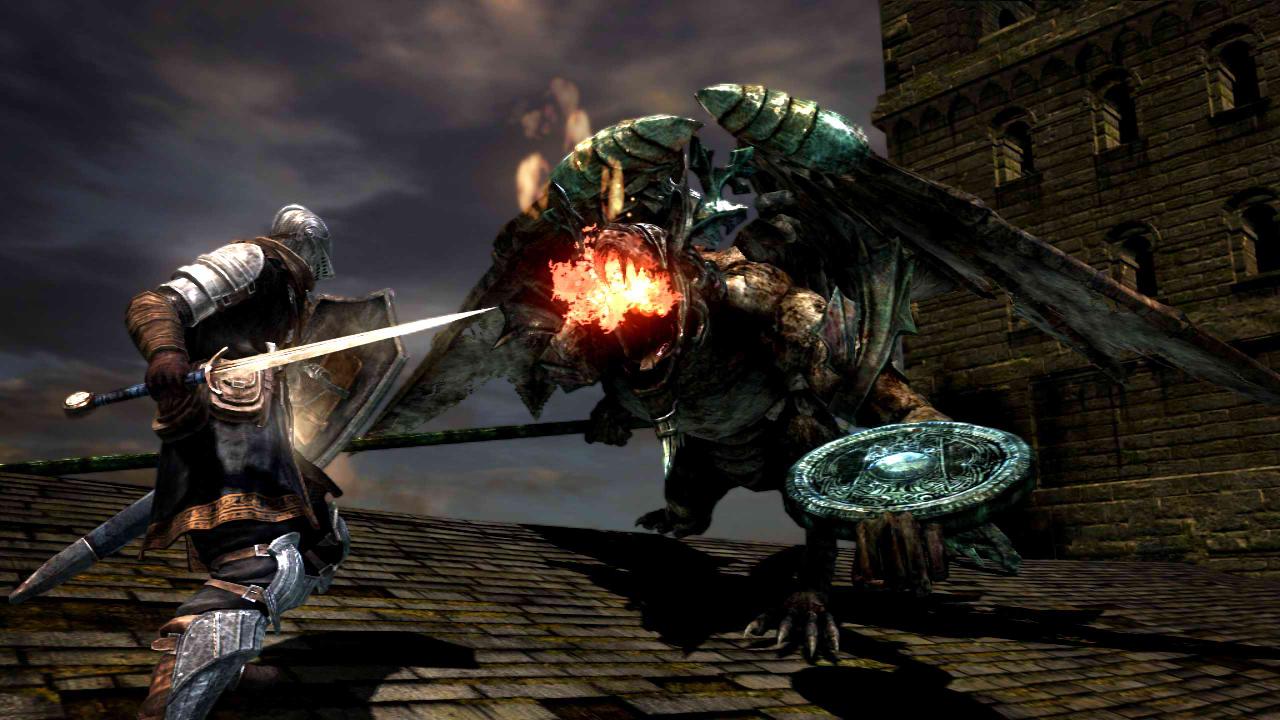
Dark Souls tells the story of your hero trying to save an intriguing world which, by every possible metric, fell long ago. Abominations make their homes in the forgotten nooks of a lost civilisation. A handful of enigmatic survivors are all that's left, but you're as free to talk to them as kill them, and they're as liable to help you as to lie. Best of all, the game literally kills you off somewhere between character creation and the first cut-scene. Above all, Dark Souls seems to thrill at escaping expectations.
An example is how your character controls. Just to swing a sword sees your avatar putting their back, shoulder and wrist into the blow, leaving you to wince at the weapon's weight. Hit attack again, and you'll roll the weapon around down, up and around, maintaining its momentum to strike once more, quicker this time. But every single attack, every block with your shield, every panicked evasive roll, takes a fat bite out of your endurance meter. Never mind whatever action games you've played before, you have to learn to fight all over again because, simply put, you're only human.
That might not sound so bad when you're gleefully taking apart a zombie with a mace. How are you going to deal with a pack of feral dogs? Or a rat as big as a Land Rover? These are the questions Dark Souls asks you, before leaning back in its high-backed leather chair to light a cigarette. It never rushes you. It never needs to. It simply tells you, to your face, that certain death lies this way. And then it tells you to walk.
Which brings us to the radioactive feather in Dark Souls' cap. Death is something you fear. If you die, you don't just get cast back to the nearest waypoint. You run the risk of losing any unspent XP or precious humanity points. Never mind fleeing from ghosts in brooding catacombs. Dark Souls can happily scare the crap out of you in broad daylight, with something as simple as a giant insect dive-bombing your head as you cross a narrow walkway.

DOWNLOAD LINK
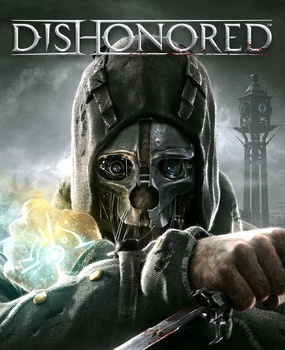
Are you getting sick of playing games that don’t actually let you play? You know the ones I mean: they funnel you down a narrow path, don’t give you much freedom in what you can do, and rely on cinematic set pieces to drive the spectacle. I am, and that’s why Dishonored is such a refreshing experience. It picks up where games like Deus Ex and BioShock left off, and puts choice back in the hands of the player.
As Corvo Attano, protector to an Empress, players find themselves in Dunwall, a grimy port city whose population is being decimated by a rat-born plague. It’s an industrial setting; a fishing town grown rich off the back of the whale oil that powers the city’s circuits. It’s also a hive of corruption, political machinations and power grabbing, and this all comes to the fore when the Empress is assassinated, and Corvo sets out to avenge her death.
That vengeance can take many forms. Unlike so many video game protagonists, Corvo is not pre-ordained to be a mass murderer. The entire game can be completed without killing a single person, so guards can be avoided or knocked unconscious, and non-lethal options can be found for assassination targets.
Of course, if you want to cut a bloody swathe across Dunwall, that’s catered for too. Just be warned: killing your way to the way to the end of the game has a number of
ramifications. More dead bodies means more rats and more guards, and a darker overall conclusion.
If you’re anything like me though, you’ll probably take an approach that’s somewhere in the middle – at least for your first play-through. Whatever you do, the mechanics are highly versatile and each setting has been designed to give players multiple options for achieving any one goal.
By way of example, in one mission Corvo has two targets to take out inside a brothel, but there is, of course, an alternative to killing them. If you can find another guest in the complex and get him to give up the code for his safe, you can then give this code to a character in the Distillery District and he’ll make both your targets disappear. In my first playthrough, I got the code, but went and eliminated both the targets anyway, then took the contents of the safe for myself.
These kind of options make missions much more engaging than if players were simply tasked with the usual 'go here, kill this' objectives. That said, it's actually the moment to moment gameplay choices that make Dishonored so compelling.
What happens, for instance, if you need to get past a 'wall of light'? These electrified gateways are set up throughout the city and will fry anything that’s not authorised to pass through them. You might be able to circumvent it by climbing up onto the rooftops and traversing around, or use the possession power to scurry through a drainage pipe as a rat and get to the other side. On the other hand you could deal with the gate itself by removing the whale oil tank that’s powering it, or hack into the system and reverse it. This last option is perhaps the most entertaining, as it means you’re now able to step through, but any guards who give chase will be instantly incinerated.


DOWNLOAD LINK
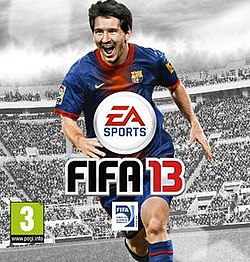
FIFA 13 continues the top-selling series from Electronic Arts in 2012. Improved career mode, enhanced online gameplay and sophisticated artificial game intelligence are just some of the features in this edition, aiming to provide the most authenticFootball experience to date.

DOWNLOAD LINK
Bundled with Valve's amazing "Orange Box" game compilation, the original Portal shocked the world with its ingenious puzzles and incredibly charming narrative when it released in 2007. While the innovative 3D puzzler was universally praised, the game did receive one major criticism. "It was too short," cried many fans. Most gamers were able to finish it within five hours. With Portal 2, Valve is fixing that issue by delivering a lengthy standalone game. In addition to offering a meatier single-player campaign, Portal 2 ups the longevity by featuring a separate two-player cooperative mode.
One of the reasons Portal received so much praise was due to its witty brand of humor. The sharp writing was carried by GLaDOS, arguably the greatest videogame villain of all time. This evil "female" robot returns to put gamers through more fun and challenging test chambers.
For those unfamiliar with the franchise, Portal requires players to use a "portal gun" to solve puzzles. Whereas guns are typically used to kill enemies, the portal gun doesn't shoot any bullets. Rather, the item allows players to teleport by shooting two different colored portals (orange and blue) along walls. For instance, players can shoot a blue portal onto an adjacent surface and then blast a subsequent orange portal to a far-away ledge. By stepping into the blue portal, players exit out of the orange portal thereby reaching an otherwise impossible-to-reach area. Using this ability, players are forced to solve intricate physics-based riddles. The puzzles in Portal 2 are even more dastardly than ever, but are even more rewarding and satisfying to solve.
Because people enjoyed playing the original Portal with the help of friends, Valve incorporated a full-fledged cooperative campaign. For the first time in the franchise, players will take control of two cutesy robotic characters and will have to work together to solve joint puzzles. Because four portals can now effectively be on screen at once, expect zany chaos to ensue. Contributing to the madness is the fact that you can jokingly kill your compatriot by sending them through a poorly placed portal. But it's okay! After all, you're robots that can easily be rebuilt!
While a cooperative mode is sure to shake things up, it isn't the only addition to Portal 2. Several new transportation tools will be at your disposal. "Excursion Funnels" will allow players to shoot beams from which they can fly through, "Aerial Faith Plates" (springboard-like devices) will bounce players to incredible heights, special different colored gels will allow players to run faster or jump higher than ever, and "Thermal Discouragement Beams" will enable players to redirect lasers to destroy turrets.
Even though these new toys will certainly add to the Portal experience, it wouldn't be a Portal game if it didn't feature an excellent narrative. Luckily, Valve is taking the polished presentation and humor to the next level. Because the game is going to be much longer than the first, Portal 2 will introduce more characters and will push dialogue even further. According to Valve, over 13,000 lines of speech are used.
Joining the beloved Ellen McLain, who reprises her vocal role as GLaDOS, are J.K. Simmons ("J. Jonah Jameson" from the Spiderman movies), and Stephen Merchant (The Office, Extras).
As the story goes, a large amount of time has passed since the events of the first game and the Aperture test chambers are no longer clean, sterile white laboratories. Rather, the environment has become run-down and dilapidated. The paint has worn off, metal pipes have rusted, and wild vines are growing rampant across the facility like mold on two-week old bread. Delivering this gorgeous visual style is the latest version of Valve's Source engine. The detail and art design of the franchise has never looked better. While Portal 2's system requirements are relatively low considering its minimum required GPU is the GeForce 7600, performance is significantly boosted with a second graphics card as SLI scales up to 92%.
So is "the cake" a "lie" the second time around? You'll have to play Portal 2 to find out for yourself.
One of the reasons Portal received so much praise was due to its witty brand of humor. The sharp writing was carried by GLaDOS, arguably the greatest videogame villain of all time. This evil "female" robot returns to put gamers through more fun and challenging test chambers.
For those unfamiliar with the franchise, Portal requires players to use a "portal gun" to solve puzzles. Whereas guns are typically used to kill enemies, the portal gun doesn't shoot any bullets. Rather, the item allows players to teleport by shooting two different colored portals (orange and blue) along walls. For instance, players can shoot a blue portal onto an adjacent surface and then blast a subsequent orange portal to a far-away ledge. By stepping into the blue portal, players exit out of the orange portal thereby reaching an otherwise impossible-to-reach area. Using this ability, players are forced to solve intricate physics-based riddles. The puzzles in Portal 2 are even more dastardly than ever, but are even more rewarding and satisfying to solve.
Because people enjoyed playing the original Portal with the help of friends, Valve incorporated a full-fledged cooperative campaign. For the first time in the franchise, players will take control of two cutesy robotic characters and will have to work together to solve joint puzzles. Because four portals can now effectively be on screen at once, expect zany chaos to ensue. Contributing to the madness is the fact that you can jokingly kill your compatriot by sending them through a poorly placed portal. But it's okay! After all, you're robots that can easily be rebuilt!
While a cooperative mode is sure to shake things up, it isn't the only addition to Portal 2. Several new transportation tools will be at your disposal. "Excursion Funnels" will allow players to shoot beams from which they can fly through, "Aerial Faith Plates" (springboard-like devices) will bounce players to incredible heights, special different colored gels will allow players to run faster or jump higher than ever, and "Thermal Discouragement Beams" will enable players to redirect lasers to destroy turrets.
Even though these new toys will certainly add to the Portal experience, it wouldn't be a Portal game if it didn't feature an excellent narrative. Luckily, Valve is taking the polished presentation and humor to the next level. Because the game is going to be much longer than the first, Portal 2 will introduce more characters and will push dialogue even further. According to Valve, over 13,000 lines of speech are used.
Joining the beloved Ellen McLain, who reprises her vocal role as GLaDOS, are J.K. Simmons ("J. Jonah Jameson" from the Spiderman movies), and Stephen Merchant (The Office, Extras).
As the story goes, a large amount of time has passed since the events of the first game and the Aperture test chambers are no longer clean, sterile white laboratories. Rather, the environment has become run-down and dilapidated. The paint has worn off, metal pipes have rusted, and wild vines are growing rampant across the facility like mold on two-week old bread. Delivering this gorgeous visual style is the latest version of Valve's Source engine. The detail and art design of the franchise has never looked better. While Portal 2's system requirements are relatively low considering its minimum required GPU is the GeForce 7600, performance is significantly boosted with a second graphics card as SLI scales up to 92%.
So is "the cake" a "lie" the second time around? You'll have to play Portal 2 to find out for yourself.

DOWNLOAD LINK
In Deus Ex: Human Revolution you play Adam Jensen, a security specialist, handpicked to oversee the defense of one of America's most experimental biotechnology firms. But when a black ops team breaks in and kills the scientists you were hired to protect, everything you thought you knew about your job changes. At a time when scientific advancements are routinely turning athletes, soldiers and spies into super-enhanced beings, someone is working very hard to ensure mankind's evolution follows a particular path. You need to discover why - because the decisions you take and the choices you make will be the only things that can determine mankind's future

DOWNLOAD LINK
Driver: San Francisco is one of the weirdest driving games ever, in the best possible way. It’s Life on Mars turned into a wheelman’s wet dream. Tanner’s ability to shift between cars at will takes what was previously a straightlaced series and makes it constantly fun, funny and chaotic. In the main story missions, it’s treated as a superpower that only Tanner and his partner are initially aware of. In side-missions, it’s cheerfully abused to hand out such objectives as coming first and second in the same race, helping a femme-fatale evade the cops and turning dangerous driving into a televised artform.
Tanner’s enthusiasm for all of these is infectious, and the fact that he’s temporarily possessing drivers instead of simply their cars makes for great in-game chatter from other terrified passengers. For instance, to convince his partner, Tanner torments a boy-racer by leaping into him and forcing him to smash into cops and leap off moving car transporters. Another couple of missions are about scaring people to the point of heart-attack through high-speed insanity. If all this wasn’t openly presented as a dream, Tanner would be the biggest dick this side of Saints Row 2. Instead, you can enjoy the ride, guilt-free.

It can be a bumpy one though, especially on PC. This isn’t a great port, starting with the fact that it quite obviously is one. Graphically, it’s unimpressive, and with no real options beyond switching antialiasing on or off. The biggest annoyance, however, is that the controls are designed for a controller with analogue sticks, and trying to play with keyboard and mouse is a recipe for insanity. You’re also stuck with Ubisoft’s DRM, which demands an online check when you fire the game up, though at least it lets you play offline after that.
Even with a controller, the actual driving is usually mediocre, with poor handling in most vehicles, and very rubber-banded races. Rarely do you come across a particularly difficult mission. This keeps the story humming along, but makes the occasional spikes all the more noticeable when they do show up.
Without its shifting element, Driver: San Francisco would be enjoyable enough mediocrity, but nothing special next to other driving games. With shifting, it’s one of the most enjoyable racing games in a very long time. Gimmicky or not, there’s a gleeful purity to Driver’s action, from its lack of gun battles and on-foot action, to the way it soon convinces you that magically weaponising oncoming traffic can be as natural as a handbrake turn. That especially is a hell of a trick.


DOWNLOAD LINK
The Back to Karkand expansion for Battlefield 3 started a war inside my head. On one side, the cynic. On the other, the boy who likes shooting things. “£12 for four old maps, ten old weapons and a few scrappy vehicles?” The cynic scoffed. “Shut up!” the boy cried. “I just killed a tank by shooting a rocket through a hole in an apartment block!” It’s an argument the cynic was never going to win.
The maps are fantastic. But then they should be: Wake Island, Gulf of Oman, Sharqi Peninsula and Strike at Karkand are all Battlefield 2 maps, rebuilt to work with the graphical power and explodiness of the Frostbite 2 engine. The four-year old architecture has been tweaked and iterated upon countless times. They’re finely honed, fair, and consistently deliver great games.

Strike at Karkand and Sharqi Peninsula provide the most memorable fights. Almost every building can be blown apart. The streets are dominated by rumbling tanks, but the warrens of narrow alleyways let assault fighters take the battle away from the monstrous vehicles. Gulf of Oman is also fantastic: its tall buildings and leering cranes offer some creative vantage points for snipers and it’s more densely urban than the Battlefield 2 original.
The slender horseshoe of Wake Island is perhaps the weakest of the bunch, but still delivers a great spectacle. Its wide open walkways and bridges are a nightmare for infantrymen on foot, and its weird shape and increased size makes it hard for fighters on one end to get to the other. It’s a great hunting ground for pilots of the F-35, however. The VTOL jet makes a return from Battlefield 2. It’s much more sluggish than Battlefield 3’s jets, but the ability to hover and pick off infantry make it a devastating and satisfying weapon.
Other returning vehicles include the speedy, vulnerable DPV buggy, the BTR-90 Armoured Personnel Carrier and a new, tiny yellow digger that DICE have added for a laugh: there’s an achievement on offer if you somehow manage to run someone over with it. Back to Karkand also contains ten weapons, all of which originally appeared in Battlefield 2. You can unlock these by completing Assignments, tasks that ask you to rack up a certain number of kills, revives and ammo supplies across the maps

The maps are top notch, but the £12 pricetag is still troubling. At almost half the price of the base game (which is required to play Karkand), we should expect a little more than a few remastered classics. Bad Company 2’s Vietnam pack succeeded because it took us into a different place where the weapons were rustier and the warfare dirtier. Back to Karkand gives us more Battlefield 3, with the same highs and lows (Battlelog is still a nuisance: long load times and regular disconnections). Back to Karkand isn’t an expansion, it’s a good but expensive map pack.
Only two of Battlefield 3’s original maps delivered the full, sprawling warfare experience of jets flying overhead as tanks duelled below. The four new maps added by Back to Karkand show Battlefield 3 at its biggest and best. It’s strange that DICE have had to reach into familiarity to really show what Battlefield 3 can do, but there’s no denying Back to Karkand’s quality.

DOWNLOAD LINK
We’ve seen a wide range of Batflavours over the years: campy Batman, angsty Batman and, thanks to writer Frank Miller’s increasing mental derailment, batshit Batman.
Here we get straight-down-theline Batman. Arkham City captures his technique, but lets some of his character slip away into the night. For a hi-tech super-ninja spandex vigilante, he is peculiarly bland.
Luckily, the Dark Knight is not a man of words, but of deeds – and this game, like its predecessor, has them nailed. Batman zip-lines, grapnels and swoops between the moonlit rooftops of this open-world city, emerging from the shadows to hammer clusters of goons. He even finds time for a spot of light puzzling and the odd platforming challenge.
The action is magicked straight from the films and comics, where discretion and detection are as important as slamming Bat-fists through the faces of the criminally insane. Well, almost as important. Batman in motion is awesome to behold: he sneaks and swoops with a deft mo-cap mastery, and annihilates room after room of thuggish mental patients with fluid violence, catching and deflecting blows in a storm of semi-procedural devastation.
The action is magicked straight from the films and comics, where discretion and detection are as important as slamming Bat-fists through the faces of the criminally insane. Well, almost as important. Batman in motion is awesome to behold: he sneaks and swoops with a deft mo-cap mastery, and annihilates room after room of thuggish mental patients with fluid violence, catching and deflecting blows in a storm of semi-procedural devastation.

It’s just a pity that whenever he opens the flap in his gigantic chin he proves to be a right old Bat-chump. The world’s greatest detective only ever seems adept at detecting the extremely obvious, and when he tries his hand at humour Catwoman tells him to shut up – as well she should. It’s wise to leave the jokes to The Joker, who returns here wittier and more weasly than ever, although looking a little worse for wear after his encounter with the Titan serum at the end of Arkham Asylum.
The plot picks up some time after Batman’s efforts mopping up the mass breakout at the maximum security mental asylum. The focus has now shifted to a larger portion of Gotham, which has been cordoned off and turned into an Escape From New York-style prison city. The why and how are barely worth acknowledging. The best Batman stories redeploy the iconic figures into larger allegories, and while this has a heavy-hitting narrative payoff in its last moment, it is otherwise nakedly a greatest hits. An excuse to cram together as many of Gotham’s notorious evildoers as possible in one confined space and have Batman beat the XP out of them one by one.
It’s not that confined though. Gone are the hubs of Arkham Island. Here we get an open world of guttering neon and gothic decay, a horseshoe of heavily compartmentalised urban squalor, surrounded by frigid water and barbed wire. It’s not the most expansive of cityscapes in gaming, and any distinct character for its various locales struggles to emerge – probably because you spend more time flying over them than actually being in them.
Nonetheless, it’s dense with diversions and detail, and Batman has full rein from the off, his utility belt immediately bristling with gadgetry that similar games would take hours to unlock. The grapnel and glide are not just ways to escape combat, but the thrilling means by which you turn the environment into your playground, soaring beneath the ghostly beam of the Bat Signal.

The central quest, when you find time for it, is a meaty thing, coming in at about 14 hours on my leisurely playthrough. It suffers a little from recycling its locations: flimsy plot elements ricochet you back and forth between the same villains’ linear lairs, and although they change a little each time, revealing new routes and the scars of the battles fought within, it does end up feeling a little like rigmarole. Nonetheless, the pace, variety and craft of each lair is expertly managed. Whereas the preceding game made a starker distinction between fisticuffs and stealth sections, here there is a more gradual segue between the massive brawls, which now fill the screen with goons, and challenges where discretion is key.
This time, the introduction of new, deadlier opponents is rapid, and the game wastes little time before throwing guns into the mix. While Batman can soak up a clip or two, prolonged exposure to gunfire leads straight to the reload screen – where, aggravatingly, your failure is further mocked by a supervillain. Tossing a few smoke pellets down while you grapnel a gargoyle high above allows you to evade their aim – so long as they don’t have infrared goggles – and the environments are riddled with interconnecting escape routes. Floor grates and ducts wind around each room, and there are plenty of low walls and drop points from which to launch an attack, before vanishing into the shadows again.
However, some fights leave you with no alternative but to dive in. As in the last game, such battles are a matter of restraint and timing. Enemies swarm you, readying themselves to deliver punches, kicks and stabs. You don’t precisely choose how Batman attacks – you select the direction of his assault and unleash the procedural animation system, shattering his opponents with a freeflowing chain of blows and building up a combo meter that allows you to deliver permanent takedowns. Button mashing gets you some way with unarmed enemies, but as the bodies crowd in, knowing when not to attack quickly becomes just as important, giving yourself time between combos to tap the counter button and deflecting incoming fists to bone-shattering effect. Batman’s solution for the criminally insane may be resolutely non-lethal, but he’s not really big on care in the community either.

These punch-ups typically last twice as long as my excitement in them, but each is initially exhilarating to behold – particularly when it all goes right. It doesn’t always go right. The battles take a lot out of your direct control in order to deliver flowing brutality, and the game’s ability to guess your intent is often stretched to breaking point. When multiple types of enemies are introduced, each requiring a specific combo, the automation with which Batman selects his next opponent becomes critical. It’s frustrating to accidentally vault into a cattleprod or waft your cape pointlessly over some inert goon, leaving the thug next to him free to heave a car door into your kidneys.
Even more aggravating are the game’s attempts to help you in combat, popping up paragraphs of tutorial text in the centre of the screen. It’s like suddenly succumbing to cataracts, mid-fight. The options to turn off such instructions are seemingly ineffective.
While the pointy-eared-one has several leads to pursue for the main mission, he has no shortage of distractions. Many of these are substantial quest chains in themselves, each focusing on a central villain. Deadshot has left plenty of perforated political prisoners for you to investigate using your detective vision to determine bullet trajectories and follow blood spatters, while Zsasz acts as the motive for a protracted point-topoint race, challenging Batman to reach the next ringing phone before he carves up another victim

By far the most diverting, however, is The Riddler, who is once again neatly used to excuse a collectibles minigame. Riddler trophies dot the alleyways, rooftops and crawlspaces of Arkham City, some placed in plain sight, others locked in elaborate contraptions that require the activation of magnets or timed tripswitches. You’ll need to trade-in these trinkets for the coordinates of Riddler’s next victim – members of a medical team he has abducted and trussed up in mechanical deathtraps.
Then there are the boss battles. At least they advance the last game’s gruelling fare of attack cycles, weak points and QuickTime Events. The best are unobjectionable and look cool, but the worst fail to communicate the route to success, or actively mislead you. One battle has respawning henchmen, but you might not realise it until you fill the room with unconscious bodies. Another villain has a forcefield that prevents direct attacks – unless they are stealthy, as I belatedly discovered. Because his forcefield wouldn’t expect that.
Working out the peripheries of the designer’s rigid plan for you is sometimes harder than it needs to be. It’s particularly true in the game’s prescriptive puzzle and platform elements, but even at the most granular level, your ability to grapnel onto things remains entirely in the game’s control, and sometimes this power is inexplicably withheld. Even so, Arkham City offers a greater level of expression through your various abilities than its predecessor, and is overwhelmingly generous with the distractions it lays before you from the get-go. Even if its fundamental fighting system strains at the seams, even if Batman himself is a bit of a plank, this is as expansive a realisation of the superhero as there has ever been.
So broad, in fact, that it’s only when every collectible has been hoovered up, every crime scene scoured, every crook crushed, that you’ll think to wonder: where was the Dark Knight’s depth?

DOWNLOAD LINK
As with so many longform fantasy RPGs, the troubles afflicting the inhabitants of Amalur can all be blamed on the actions of a single mad gnome. Stupid gnomes.
This time one of them has decided to build a device called the Well of Souls to bring people back from the dead. You, a third-person fantasy hero, are its first and last success.
The device is conveniently exploding when you wake up, so your first task is simply to escape the collapsing caverns that house it. Next thing you know, you’re in the Faelands, an idyllic realm under threat from a mad elf king and the dark god he’s trying to summon. You must save the land. This being a combat-driven RPG, you must do so by hitting things. Lots of things.
Returning from the dead has its consequences, however. You’re not a zombie in the grey, smelly, decomposing sense, but being alive when you shouldn’t be has supposedly jolted your character out of the grooves of fate that determine the life and death of every creature in Amalur, giving you the ability to change the fate of those around you. That’s the theory, at least.
 In reality, at points in the story you’re told that by dicing-up a murderous creature you’ve saved the lives of those it was ‘destined’ to kill. But as these moments are entirely dictated by the linear plot, your ability to mess with fate never has any real impact on the world. You mostly just hit things.
But while you can’t actually wreak havoc on the natural order, your alleged ability to do so attracts the interest of the great and powerful in the land. It’s not long before you’re recruited by the leader of the good Fae, the king of Summer, and sent off on a journey east to the crystal palace built by the evil king of Winter, leader of the bad Fae, to thwart his crazy plan.
Getting to him will take a long, long time. Your quest will take you through a series of wide open zones, each of which contains a central hub town. These vary from small clusters of huts to small forts, and all contain half a dozen villagers standing under yellow exclamation marks, ready to send you on quests to slay monsters or retrieve valuable items from the surrounding wilds. You can choose to follow the main quest strand, which leads you on a linear path through the Faelands, or to linger and take your pick from a number of dull sidequests.
Alternatively, you can join one of Amalur’s five factions, and complete their individual storylines for greater rewards. Whatever you decide to do, it will involve hitting a lot of monsters, and hitting monsters is what Amalur does best.
In reality, at points in the story you’re told that by dicing-up a murderous creature you’ve saved the lives of those it was ‘destined’ to kill. But as these moments are entirely dictated by the linear plot, your ability to mess with fate never has any real impact on the world. You mostly just hit things.
But while you can’t actually wreak havoc on the natural order, your alleged ability to do so attracts the interest of the great and powerful in the land. It’s not long before you’re recruited by the leader of the good Fae, the king of Summer, and sent off on a journey east to the crystal palace built by the evil king of Winter, leader of the bad Fae, to thwart his crazy plan.
Getting to him will take a long, long time. Your quest will take you through a series of wide open zones, each of which contains a central hub town. These vary from small clusters of huts to small forts, and all contain half a dozen villagers standing under yellow exclamation marks, ready to send you on quests to slay monsters or retrieve valuable items from the surrounding wilds. You can choose to follow the main quest strand, which leads you on a linear path through the Faelands, or to linger and take your pick from a number of dull sidequests.
Alternatively, you can join one of Amalur’s five factions, and complete their individual storylines for greater rewards. Whatever you decide to do, it will involve hitting a lot of monsters, and hitting monsters is what Amalur does best.
 Three skill trees are gradually unlocked as you slay foes and complete quests for experience. Might will give you more attacks with longswords, greatswords and five-foot mallets. The finesse tree will let you sneak more effectively, and make you more efficient with knives. The magic tree will unlock powerful spells and increase your damage with chakrams: sharp circular boomerangs designed to keep enemies at range.
You can further specialise in sneaking, smashing or spellcasting by equipping the relevant destiny card. These will further boost relevant skills, increasing melee damage if you’re a fighter and improving your mana pool as a spellcaster. It’s a flexible system. You can visit NPCs to reset skill points and equip a different destiny card wherever you are to instantly change your speciality. As you grow more powerful, you’ll unlock dual-class destinies that let you wield a wider range of weapons more effectively.
Amalur’s willingness to let you try out all its toys is one of its best points. All of its weapons are fun to play with, and high-level magic can be supremely satisfying.
You’ll commonly fight groups of half a dozen enemies. Your weapon swings are tied to the left mouse button, special abilities such as spells to the right. The latter can be switched by selecting different abilities from a taskbar. Judicious amounts of rolling and blocking are needed to dodge attacks and set up your combos. With a few skill points in the right tree, melee weapons gain charged-up heavy blows and new combos from rolling and blocking stances. If you chain these attacks just right, you can keep your enemies in the air for the entire fight.
Three skill trees are gradually unlocked as you slay foes and complete quests for experience. Might will give you more attacks with longswords, greatswords and five-foot mallets. The finesse tree will let you sneak more effectively, and make you more efficient with knives. The magic tree will unlock powerful spells and increase your damage with chakrams: sharp circular boomerangs designed to keep enemies at range.
You can further specialise in sneaking, smashing or spellcasting by equipping the relevant destiny card. These will further boost relevant skills, increasing melee damage if you’re a fighter and improving your mana pool as a spellcaster. It’s a flexible system. You can visit NPCs to reset skill points and equip a different destiny card wherever you are to instantly change your speciality. As you grow more powerful, you’ll unlock dual-class destinies that let you wield a wider range of weapons more effectively.
Amalur’s willingness to let you try out all its toys is one of its best points. All of its weapons are fun to play with, and high-level magic can be supremely satisfying.
You’ll commonly fight groups of half a dozen enemies. Your weapon swings are tied to the left mouse button, special abilities such as spells to the right. The latter can be switched by selecting different abilities from a taskbar. Judicious amounts of rolling and blocking are needed to dodge attacks and set up your combos. With a few skill points in the right tree, melee weapons gain charged-up heavy blows and new combos from rolling and blocking stances. If you chain these attacks just right, you can keep your enemies in the air for the entire fight.
The device is conveniently exploding when you wake up, so your first task is simply to escape the collapsing caverns that house it. Next thing you know, you’re in the Faelands, an idyllic realm under threat from a mad elf king and the dark god he’s trying to summon. You must save the land. This being a combat-driven RPG, you must do so by hitting things. Lots of things.



TORRENT LINK
Pro Evolution Soccer 2013-SKIDROW Repack Full
Pro Evolution Soccer 2013 (c) Konami
18-09-2012......Release Date - Protection........SerialSecuROM
Soccer.............Game Type - Disk(s)....................1 DVD

RELEASE NOTES

Pro Evolution Soccer 2013 returns to the roots of football with unique
levels of control plus major emphasis on the individual style of the
world's best players. Thanks to feedback from dedicated fans, PES2013
offers total freedom to play any kind of ball, which for the first time
includes full control over shooting and the first touch. Endorsed by
Cristiano Ronaldo, PES will continue to push boundaries, perfectly
reflecting the genius of top level players and capturing the essence
modern day soccer to date.

Features:

PES FC Puts the Control In Your Hands - Full control takes PES gameplay
to a new level

- Players now have the freedom to dribble, and pass however they choose
- Dynamic first touch allows fans to trap and move the ball to create
flowing movement
- Response defending vastly improves the accuracy, timing and options
to break up play

Introducing Player ID - A distinct identity

- The physical features and skill sets of the world's top footballers
have been faithfully recreated
- Celebrations, actions and goal keeper animations are now more
tailored to real life than ever

Introducing ProActive AI - The AI engine under-goes another massive
year over year improvement

- ProActive AI means player and team decisions and movement are refined
even further
- Balance between attack and defense is honed and speed adjusted for
greater realism and control
- The PES team worked with real life goal keepers to improve motions ad
GK logic to improve animations and quality of GK responses

INSTALL NOTES

2. Mount or burn image
3. Install
4. Block the game in your firewall and mark our cracked content as
secure/trusted in your antivirus program
5. Play the game
6. Support the companies, which software you actually enjoy

REPACK NOTES

NOTHING REMOVED.. :)

Torrent link
The chronic oversaturation of the mafia in our international media has taught us much. Mafia II is an attempt to chronicle these teachings in game form. Fact number one: mafia men do lots of killing. Fact number two: they like suits. Fact number three: mafiosa don’t call each other mafiosa; they use the term ‘wiseguys’.
I’ve cross-referenced facts one and two with Mafia II, and they’re definitely right – a lot of killing and a lot of suits. Fact number three isn’t. ‘Wiseguys’, with its implied streetsmarts and cunning, doesn’t fit Mafia II’s mobsters. It certainly doesn’t fit the mid-level gangster the game asked me to tail early in its middle act, who didn’t have the presence of mind to check his rearview mirror as he drove away from a literal hatchet job. Had that guy done so, he’d have seen Sicilian-born WWII veteran and new-boy mobster Vito Scaletta about 20 feet behind, dressed in a red and white cod- Hawaiian shirt, driving a hot pink corvette with ‘BUMS12’ proudly displayed on the numberplate. That guy was not very wise.
Wise up
The other guy was me, and I was trying to be too wise. As Mafia II’s protagonist, my first attempt to trail the escaping mobster ended in failure after my original car choice – an inconspicuous ’50s saloon – was outpaced with ease on the motorways. I only chose that car, snatched unattended with a bit of pavement minigame lockpicking, to satisfy the mission briefing, which said my mark would notice anything too obvious. Dutifully I wrested against the vehicle’s slightly clunky era-specific handling to try and keep pace. But after my AI target had pranged his own vehicle six times against anything and everything in his path, I realised that such forwardthinking wiseguyishness wasn’t entirely necessary on my part.
That Mafia II so effectively harpoons its illusion of real life, showing its characters to be machines acting out prescribed paths, is to its detriment. But the fact that I bought into it in the first place is the game’s greatest strength.
It’s not that Vito is a sympathetic character. Returning from a war he held no moral stake in – after a botched robbery, it was that or prison – he joins the local mafia, even though his mum told him not to. Naughty. From there on, he relies upon menace through the typical mafioso triple-threat: punching, shooting, and scary staring. Best buddy Joe occasionally dips a toe into ‘comic relief’ territory, but then ducks back into ‘just a bit nasty’ land, gets his pistol and shoots everyone in comic relief territory. Those poor clowns.
The player’s supporting cast eschews any chance to get really creative, instead furnishing the game with another layer of dark-suited, dark-haired professionals, hitmen and higher-ups that blur into one mass. Driven by his need for money and respect, Vito is encased in a series of ever-widening shells, each step up the mafia ladder (a ladder made of guns) giving a new set of faces to watch in cutscenes: but they’re all congealed clichés, culled from a hundred Bronx Tales and Godfathers. The dialogue is wellwritten and excellently acted, but it feels mechanical, the spoutings of a supercomputer sat in a shady office with its dials set to ‘lightly-accented macho threat.’
City of dreams
It was the city that drew me in. An amalgamation of New York’s streets and Hollywood’s hills, Empire Bay is as interactively sterile as all other ‘open-world’ game-cities, but it’s been coated in a veneer of dreamy credibility. Each street and hallway has a feature – a man shouting at an open window; a woman pressing her ear to a door; the sound of an argument. It’s easy to see these details written down in a design document, but it gives Empire Bay a genuine rhythm, a pulse that Liberty City lacks. Plus, it helps that it is – on hefty machines – stunning. Turn up in the city in winter, and the streets are caked in snow, with layered bands of crystalline white on the untrodden paths contrasting with slush on the roads. And the lights! Even as the game transitions out of the 1940s and into the ’50s, Mafia II’s waxy lighting remains consistently arresting, casting pools of gold and yellow on windscreens.
But there’s no point to any of it. The city breathes and grows, changing as the missions span the years, but it never moves or cries out. The game is presented in chapters, and each chapter has you wake up in your home. Vito, I can inform you, is a man who sleeps in the same vest and pants for nine years. Before the poor, smelly bugger can even get dressed, he’s hit with news and a job. The game forces you to drive to a location: once there, Vito either shoots some men, punches some men or drives to another location.

As their cheery local mafia man, I’d pop in to see my contacts. Need any guys whacking today? Anything nicked? Want me to punch a lady? I was good at all these things. But, always, no. To deviate from the missions just wastes time: you can rob shops, but won’t procure much loot; you can pester civilians, but will only get police pressure. For a city dripping with incidental detail, the game slapped on top of it has none. Not that this is a mechanical problem – 2K Czech have never made any bones about Mafia II being a linear experience – but when the city itself looks so inviting, it’s a shame you can’t do more.
Incidental chaos
Unless you make your own fun, that is. I enjoyed people-watching in a city where every pedestrian and car driver has the situational awareness of a frightened rabbit. Drive near one of the AI humans on foot and their preset reactions kick in, launching them in a seemingly random direction. Sometimes, this would be toward safety; more regularly, they’d hurl themselves into speeding traffic.
Having a woman – a few moments earlier happily strolling down a sunny street – chuck herself in front of a nearby van is certainly a surprise. Having that van then swerve to try to avoid her and plough through another three pedestrians is brilliant. Having that van then be spotted by a police car, having those police open fire before getting squished by the panicky, blood-leaking van driver, is better than another cover-shooting ‘kill 50 goons’ story mission.

And those are too regular. Combat is supported by a pleasing system of gunplay that leads to weighty, inaccurate firefights heavily reliant on ducking behind cover. The enemy AI – so stupid at the wheel – doesn’t redeem itself through Mafia II’s battles. Bad guys just pop up and down from the same spots of cover like sharply dressed moles: whacking them is simply a matter of waiting. Early in the storyline, Mafia II displays a convincing unwillingness to murder indiscriminately, surmising that the repeated and wholesale murder of swathes of humanity isn’t the mafia’s major focus. This was the time I built my connections, prepared my lip for wobbling when my contacts became friends and my friends went to sleep with the fishes, as all mafia friends do. But then, three quarters of the way through, it forgets all that, and puts you up against waves of baddies, dehumanised after all that work to build Empire Bay’s factions into tangible things.
Mafia II is a mafia movie run once through a game grinder, and that’s simultaneously the worst thing about the game and the compliment it was developed for. In telling a story as convincing as most Hollywood depictions of the Cosa Nostra, 2K Czech have accomplished exactly what they intended to: only at the end does the artifice topple slightly, piling one too many game-cliché mass-battles onto the pile. But detach the story from its very familiar housings, and we’re not left with much: a bit of walking, a lot of driving and too much shooting. Each is good, but rarely superb.
Even supported by a neat script and great voicework, Mafia II is treading ground already chewed up by cinema’s very best. On that level, it can’t compete. On the level it can – that of the gorgeous Empire Bay – it shows an unwillingness to try. It’s a compelling experience, but an offer you can refuse.

Torrent Link
Medal of Honour citation: Sergeant First Class xSN1PERRx, pretend videogame army, distinguished himself with actions not quite above the Call of Duty while serving in Afghanistan as a super-secret megasoldier operating in a hush-hush ‘Tier One’ unit, sometimes switching brains to become a frontline grunt who learned about the futility of war and stuff like that.
Sergeant xSN1PERRx spent eight hours trudging around a geographically accurate but worryingly beige combat zone in southern Afghanistan. While on duty dressed in the skin of both Tier One operators and Army Ranger, he was ambushed repeatedly by infinite streams of Taliban fighters. Facing their withering assault, Sergeant xSN1PERRx was able to identify and click on each of their heads in turn until they fell down and their bodies disappeared.

Sergeant SN1PERRx willingly gave his life, choosing to hurl himself into a room waving a shotgun after his teammates told him to hang back, because he was bored of staring at yet another brown rock. His extraordinary badassishness and mouse-wielding ability are in keeping with the highest traditions of videogame service and reflect great credit upon himself, and acceptable credit on Medal of Honour’s developers. Now he’s dead, 75%. OMGLOL.
Blood and tiers
Let’s take a moment to salute our fallen brother. Have you saluted your monitor? Good. Medal of Honour is very strict about that kind of thing. It’s a shooter made with the close involvement of real-life soldiers: special forces so classified that before the game was released, publishers EA could only show them off with their faces hidden and their voices masked. Their input was intended to give the game a sense of respect and understanding for the soldiers involved.

It’s a fine line to walk, ruminating on the nature of the warrior in a game about inserting digital bullets in skulls, and MoH stumbles regularly. At times, it goes mawkish, the overt sentimentality of years of battlefield cooperation squidged into an ill-fitting shooter template. There are a lot of cod-meaningful man-glances that feel forced, busting in on your good shootin’ time with slow-paced cinematics.
On the other side, attempts to even the conflict and move it away from goodies vs baddies are undermined by a black and white approach. Almost every soul who lives in the game’s southern Afghan region of Takur Ghar takes potshots at you within milliseconds of you arriving in their area; those that don’t are goats. If Medal of Honour’s enemy count is even vaguely accurate, the coalition forces in Afghanistan are outgunned seven hundred to one. New fighters pop into existence every couple of seconds in the game’s lengthy and repeated ‘defend until extraction’ objectives. These vignettes are tense but tiresome: in a real battle they’d be frantic scraps for seconds of life; in Medal of Honour, they’re click click click from behind the same point of cover until a timer ticks down to zero.

But damn, if I didn’t get suckered in. The first section of the game is in the secret shoes of Tier One operators, and feels resolutely retro in its approach: four men versus the world. Halfway in, you get control of an Army Ranger – a more typical grunt. Before, I was an extension of the nighttime scenery, silently killing in the dark. In the combat boots of the Ranger, the rocks and dust of Afghanistan itself seemed to want to kill me, twatting mortar strikes and RPG fire into my landing point. My helicopter ride downed, I felt a minuscule approximation of the confusion and panic EA’s co-opted soldiers mentioned in their pre-game primers. For a short while following that ambush, every “OO-RAH!” that I’d otherwise have winced at became a statement of intent, every kill-shot a revenge strike for the unfair murder of my pretend buddies. Much more and I’d have broken out whooping “USA! USA!” Tough to explain to the office. By the time I was stuck in the bed of a valley with my Ranger squad, tributaries of Taliban forming a river of pissed-off militants, I’d lost my cynical critical connection, and was genuinely wishing for evacuation. I didn’t want to die in the dust.
That was a high point. Prior to the stand in the desert, Medal of Honour isn’t sure what it is. The first segment of Tier One missions are Call of Duty rejects, cod-CoD gimmicks that get used once or twice then tossed. As decreed by ancient law or something, I was forced to direct shots fired by everyone’s favourite military namedrop, God’s own giant fucking plane o’guns – an AC130. I aimed a screen-filling sniper-rifle repeatedly, puncturing heads from a kilometre away as my spotter called out targets in a watered down version of Modern Warfare’s silky ‘one shot, one kill’ mission. When MoH isn’t trying to ape its peers, it fares a lot better.


